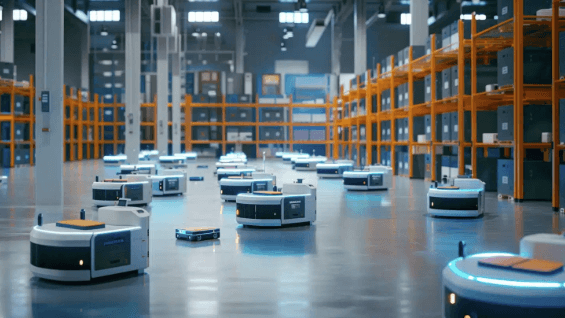
Automation in Supply Chain Management
Automation in supply chain management replaces manual tasks with automated systems, delivering consistent timing and accuracy. It boosts throughput, reduces errors, and shortens cycle times while redirecting effort to higher-value activities. The approach links process optimization with cognitive automation, improving visibility and decision loops. Measurable gains emerge in procurement, warehousing, and fulfillment, supported by a structured evaluation framework, scalable paths, and governance. The path from pilot to scale invites scrutiny of metrics, risks, and sustained improvement.
How Automation Transforms Inside the Supply Chain
Automation reshapes internal supply chain workflows by replacing manual, repetitive tasks with automated systems that execute with consistent timing and accuracy.
The analysis logs measurable gains in throughput, error reduction, and cycle-time compression, enabling teams to redirect effort toward higher-value activities.
Process optimization and cognitive automation collaborate to streamline decision loops, enhance visibility, and sustain continuous improvement across procurement, warehousing, and fulfillment domains.
Evaluating Automation Technologies: What Works for Your Network
Evaluating automation technologies requires a structured analysis of how different options align with the network’s existing processes, data flows, and performance targets. Decisions hinge on data governance maturity, interoperability, and measurable ROI. Systematic comparison highlights risks and recovery plans, guiding change management strategies that sustain adoption.
The outcome is a balanced roadmap, prioritizing high-impact, low-friction solutions aligned with governance standards and operational precision.
Implementing Automation: From Pilot to Scale
How can a pilot program be systematically translated into scalable automation within supply chain operations? A disciplined transition maps pilot outcomes to standardized processes, scaling via modular architectures, staged investments, and repeatable workflows.
Success hinges on pilot funding alignment and rigorous change management, ensuring governance, training, and risk controls accompany deployment while continuous data-driven optimization refines capacity, throughput, and cost-per-unit.
Measuring Impact: KPIs, Risks, and Governance
Measuring impact in automation-driven supply chains hinges on a rigorous framework of KPIs, risk indicators, and governance mechanisms that translate pilot results into actionable performance metrics.
The approach emphasizes measurement governance and transparent dashboards, linking operational data to strategic targets.
Risk assessment informs remediation prioritization, while governance ensures compliance, accountability, and continuous improvement, fostering freedom through disciplined optimization and data-driven decision making.
Frequently Asked Questions
How Do Humans and Robots Collaborate on the Warehouse Floor?
Human-robot collaboration optimizes workflows on the warehouse floor, reducing repetitive strain while maintaining throughput; robots handle heavy lifting and precise picking, humans supervise and adapt, enhancing warehouse floor ergonomics through data-driven, process-oriented, optimization-focused collaboration that supports worker autonomy.
What Are the Total Lifecycle Costs of Automation Systems?
Automation budgeting and system depreciation define total lifecycle costs, with initial capex, ongoing maintenance, and eventual upgrades. The analysis tracks acquisition-to-disposal, cash flow timing, and optimization opportunities, presenting actionable, freedom-seeking insights for informed, data-driven decision making.
Which Data Standards Enable Seamless Automation Integration?
Data standards enable seamless automation integration, providing interoperability, consistent schemas, and semantic clarity. The approach emphasizes modular, scalable interfaces, open protocols, and rigorous validation, guiding an optimization-focused, process-driven path toward flexible, freedom-oriented, data-driven supply chain orchestration.
See also: Automation in Household Technology
How Is Workforce Retraining and Change Management Handled?
Workforce retraining is guided by structured change management, emphasizing workforce reskilling initiatives, clear KPIs, and phased implementation. Data-driven dashboards track adoption, ROI, and competency attainment, enabling optimization of training pipelines and ensuring freedom to adapt to evolving automation demands.
What Happens to System Uptime During Peak Seasonal Demand?
System uptime increases with robust peak demand management; during seasonal throughput, line efficiency constraints are mitigated, producing stable performance. Data-driven monitoring reduces variance, enabling optimization of resource allocation and scalable capacity to sustain uptime during peak periods.
Conclusion
Automation weaves through the supply chain like synchronized gears, turning raw data into precise motion. From pilot tests to full-scale deployment, the narrative is one of measurable throughput, reduced cycle times, and near-perfect accuracy. Each KPI is a compass, guiding governance and risk controls as processes tighten and collaboration accelerates. The result is a defensible ROI: a resilient network where visibility drives continuous optimization, risks are bounded, and performance improves with every automated handoff.